
An Interview with Dr Gavin Flood

Professor Gavin Flood is a British scholar of comparative religion, specialising in Shaivism and phenomenology.
He has served in the Faculty of Theology at the University of Oxford and as the Academic Director of the Oxford Centre for Hindu Studies.
In an interview with Gayatri Ranganathan, he explains the basic tenets of Kashmir Shaivism.
Gayatri Ramanathan: What is Kashmir Shaivism and what are its distinguishing features?
Kashmir Shaivism refers to the religion focussed on Shiva that developed in the early medieval period (post-Gupta) in Kashmir, based on a new revelation of texts known as Tantras. It is characterised as being philosophically non-dualist in contrast to the Shaiva Siddhanta. It developed as both a ritual and gnostic system, although the ritual substrate had faded by the late 19th century. Kashmir Shaivism in the late 20th century was particularly associated with Lakshman Joo, who inherited the gnostic dimension of the tradition.
GR: Could you take us through the evolution of Kashmir Shaiva thought from the time of Vasugupta until it peaks with Utpaladeva and Abhinavagupta?
Vasugupta (8th-9th CE) claims that he received a revelation from Shiva embodied in the Shiva Sutras. These are pithy, enigmatic verses with a commentary by the non-dualist philosopher, Kshemaraja. The doctrine presented is a non-dualism, where the individual self is identical with the pure, absolute consciousness that is Shiva. Vasugupta also composed the Spanda Karikas, the verses on ‘vibration’, which reflects the influence of Shakta traditions upon his thinking, again with a commentary by Kshemaraja.
An important work probably a little later than Vasugupta is the Shivadrishti by Somananda, who is followed by Utpaladeva, an original thinker, who develops philosophical non-dualism that came to be called the philosophy of recognition or Pratyabhijna.
This is the doctrine that the self recognises itself as pure consciousness. This school of thought was inherited by Abhinavagupta (c. 975-1050 CE) whose guru’s guru was Utpaladeva was his guru's guru. Kshemaraja, the student and nephew of Abhinavagupta, also develops the philosophy of non-dualism, strongly influenced by Shakta or Goddess traditions.
GR: What is the relationship between Trika, Kaula, and Pratybhijna? Do they belong to the same school of thought?
The Pratyabhijna is the school of ‘recognition’. This is a philosophical tradition of commentary, especially on Utpaladeva's verses on the Recognition of the Lord (Ishvaraprayabhijna karikas). We could say that the Pratyabhijna is the philosophical articulation of non-dual philosophy enacted ritually and in meditation in the Trika and Kaula traditions.
The Trika is a tradition distinct from the more orthodox Shaiva Siddhanta. It is focussed on Shiva as Bhairava but also on the Goddess at its esoteric heart. It is called Trika or 'threefold' because its focus of worship is on three Goddesses: Para, Parapara and Apara who are emanations of the supreme Goddess (called Kalasamkarshini).
The Kaula tradition also worships the Goddess and is non-dualistic in its philosophy but also in its practice, in the sense that it rejects any duality between purity and impurity and is famous for its transgressive rituals involving, for example, sex outside of caste boundaries in order to realise the practitioners' identity with the Goddess or Shiva.
So, the Trika, Kaula and Pratyabhijna share a non-dualistic philosophy of life. Both the Trika and Kaula are entered through initiation. I suppose the Pratyabhijna is the philosophy, and the Trika and Kaula are the religion.
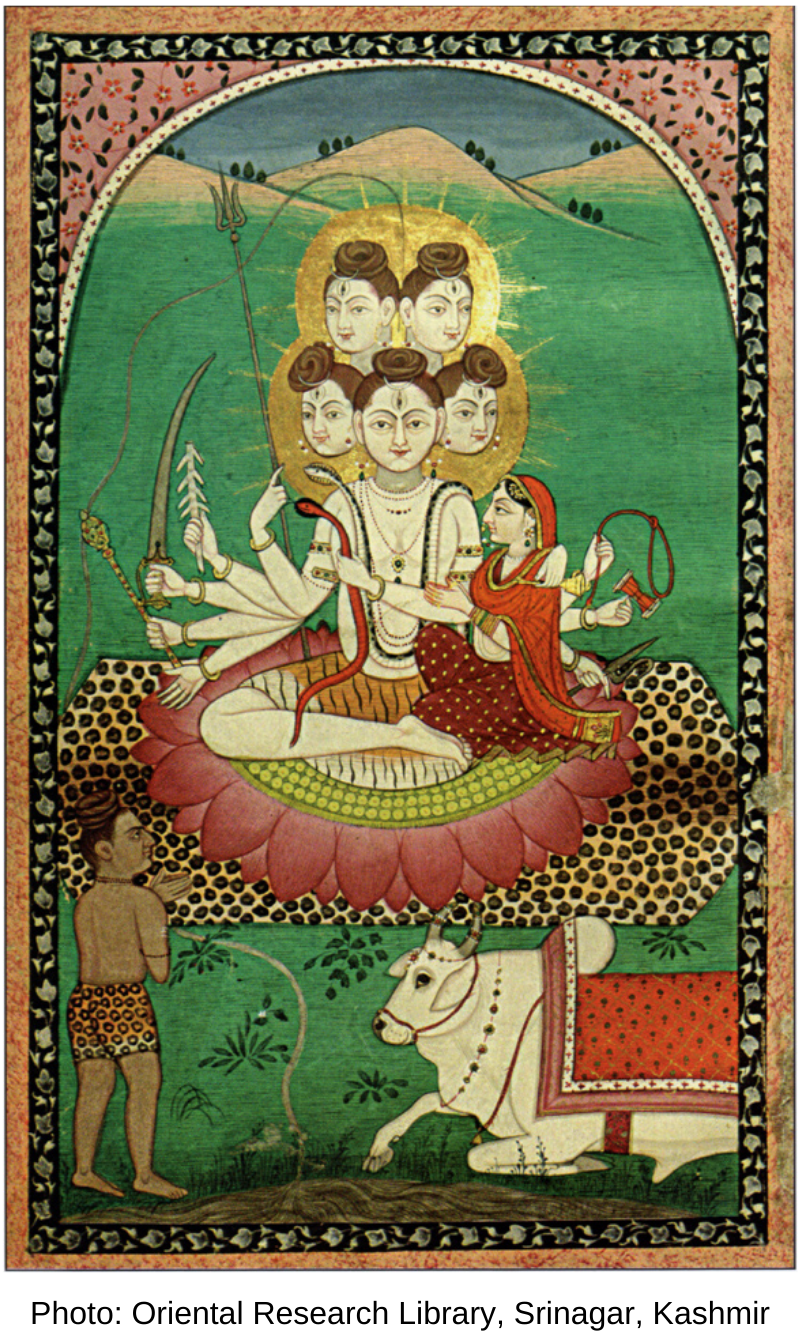
GR: How is Kashmir Shaivism different from other prevalent Shaiva philosophies of the time?
Kashmir Shaivism, which is a shorthand for the Trika, Kaula and other groups, is different from the Shaiva Siddhanta or more orthodox Shaivism. While the Shaiva Siddhanta is philosophically dualistic, maintaining an eternal distinction between self, Lord, and universe, Kashmir Shaivism is non-dualistic. Also, Kashnmir Shaivism maintains that liberation is recognising one's identity with pure consciousness, while the Shaiva Siddhanta maintains that liberation is to become equal to Shiva (shivatulya) but retaining an ontological distinction.
Kashmir Shaivism uses transgressive methods to attain liberation and magical powers, whereas the Shaiva Siddhanta is generally non-transgressive. But the transgression of Kashmir Shaivism is not necessarily anti-social, in the sense that this is one's secret or inner identity. Externally the practitioner follows the ritual patterns and injunctions of the Shaiva Siddhanta while retaining worship of the Goddess, for example, as an inner identity.

GR: What happened to Kashmir Shaivism in the intervening centuries between its eclipse in Kashmir and its rediscovery in contemporary times?
After Abhinavagupta, intellectually Kashmir Shaivism does not develop new innovations. There is no Buddhist response, for example, to his critique, and intellectually the tradition goes into abeyance, at least that's how it seems to me. But certainly, a ritual tradition continues and a gnostic tradition too. The ritual tradition was still in existence in the 19th Century according to Buhler, but seems to have gone in the 20th, leaving only the gnostic tradition unsupported by a ritual substrate. Lakshman Joo was the last in a lineage of gurus. The tradition was discovered by the westerners in the 1960s and now exists as a living tradition in the USA and Europe with westerners claiming to have inherited the tradition, and teaching Kashmir Shaivism as gurus.